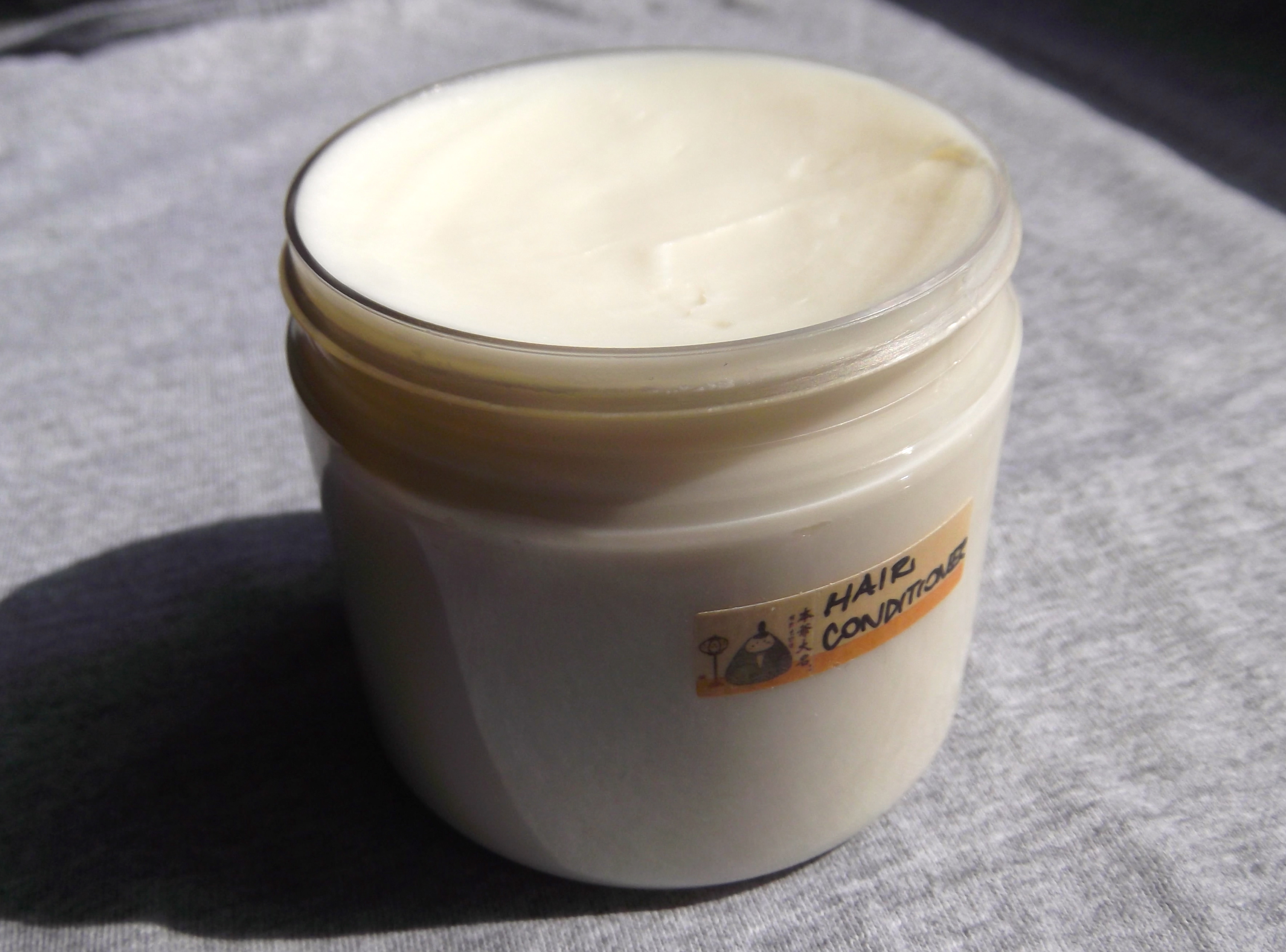
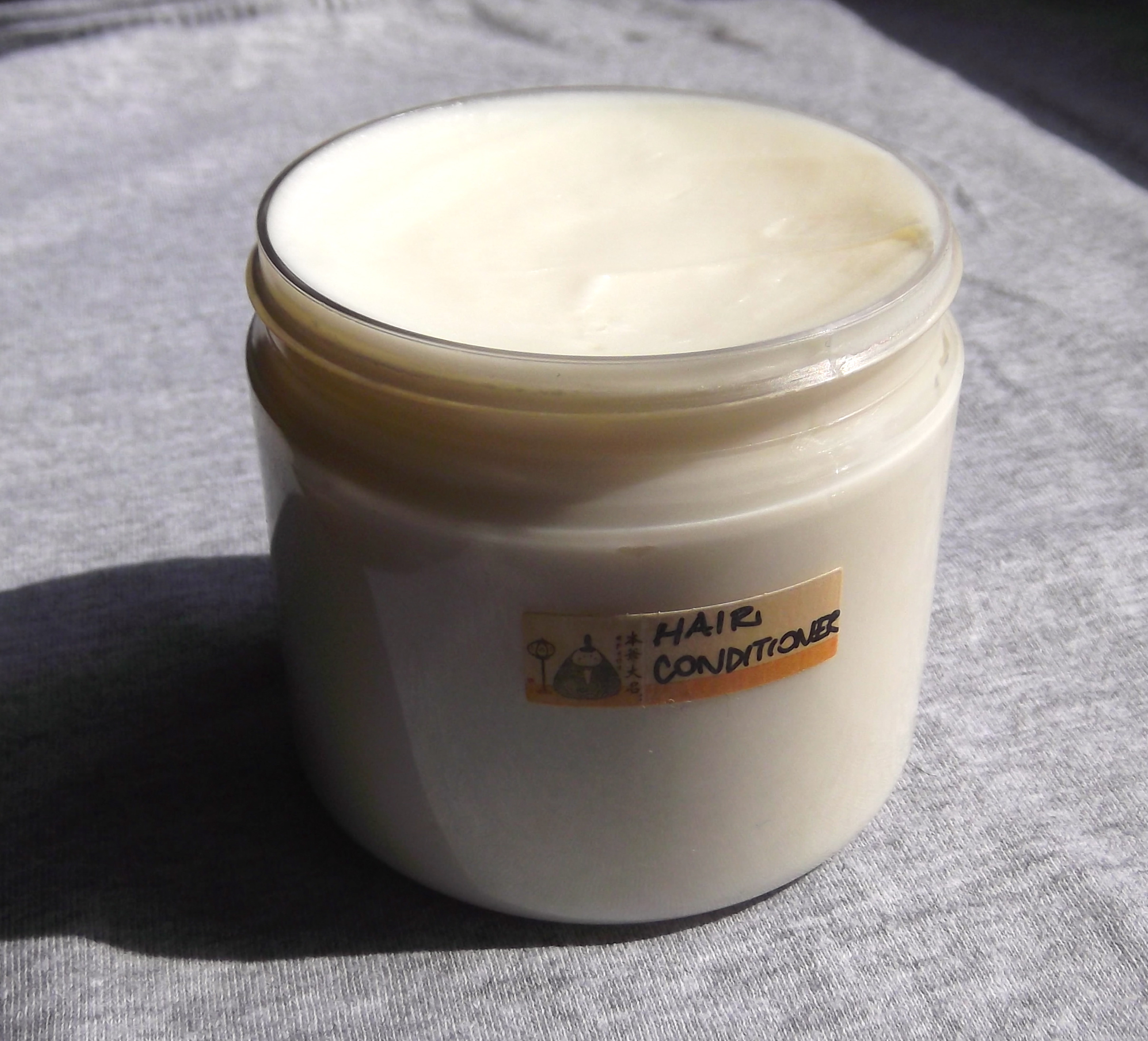
Hair Conditioner Recipe (and THEORY)

Hair Conditioner Recipe

LAB NOTES & SAFETY NOTICE
These are personal experiments for educational use only— not instructions and not for commercial or consumer use. By proceeding, you assume all risks related to safety, testing, and regulatory compliance.
[Full Legal Disclaimer & Safety Requirements]

Hello 😀
Today I would like to show you a basic recipe for a good Hair Conditioner 🙂
The formulation for a lotion and an hair conditioner are similar but not same: there are some basic differences that, if not followed, might make you fail.

So!
There is still a Phase A and a Phase B BUT! while in the making of a lotion you add the heated Phase B to the heated Phase A… here you MUST do the opposite!
You must pour the Phase A into the Phase B. This is very important!

The second difference is that there is not a proper Phase C because every extra ingredient (which should be added when the Phase A and B are already emulsified and at room temperature) has to be added singularly… ONE BY ONE! 🙂

Apart from these two big differences, however, everything else is quite same! 🙂

Phase A:
Water to 100 (explanation HERE)
Glycerin 3
Guar Hydroxypropultrimonium Chloride 0.1 (this is a very good ingredient in a hair conditioner or even in a shampoo, but don’t use it at higher concentration than 0.1-0.15% – However if you don’t have it, you can use instead a water where you had infused Mallow or Flax Seeds)
Heat this phase up to 75° (absolutely check the termometer!)

Phase B:
Esterquat 8 (this is a CATIONIC emulsifier, therefore it is different from the emulsifiers which we have in our lotions. It is important that you use an emulsifier specifically for hair conditioning 🙂 this substance in the specific is very good because it is eco-friendly 😉 )
Jojoba oil 2
cetyl alcohol 3.5
stearic acid 1.5
Heat this phase up to 70°

“Phase C” (but remember you have to add them one by one and in this order)
Hydrolized wheat protein 3
Panthenol 1
Poliquaternium-7 2 (this enhances the conditioning ability. If you don’t have it you can skip it)
Preservative 0.5-0.6 (or whichever concentration the preservative you are using needs to be!)
Fragrance oil or Essential oil depending on your taste 😀

DSCF3512

Have a great day!!! 😀


Creative Commons License
This work is licensed under a Creative Commons Attribution-NonCommercial-NoDerivatives 4.0 International License.

Lavender and Verbena Soap Recipe (palm free)

Lavender Verbena Soap Recipe

LAB NOTES & SAFETY NOTICE
These are personal experiments for educational use only— not instructions and not for commercial or consumer use. By proceeding, you assume all risks related to safety, testing, and regulatory compliance.
[Full Legal Disclaimer & Safety Requirements]

If you don’t know how to make soap, just follow the link HERE! 😀

For the others of you who already make soap… here is the recipe for 1 Kg of soap:

300 gr Coconut oil
400 gr Olive oil
150 gr Shea butter
50 gr Castor oil
50 gr Cocoa butter
50 gr Almond oil

330 gr water
142 gr lye (6% discount already included)
Temperature of the oils and lye when united: 38°

Once I reached trace I separated the soap paste in two bechers.
In one I added:
– 20 ml Lavender Essential Oil
– Purple CP color

In the other I added:
– 20 ml Verbena Essential Oil (this is one of the few citrusy Essential Oil smells to actually keep persistent in a cold process soap! 😀 I love it!)
– Apple CP color

I also added small balls which I had made with pieces of an old soap 🙂 of course this is not useful and you can decorate your soap as you like! 😀

Hope this was helpful 🙂

The recipe is also Palm free 🙂

DSCF3500

Have a great day! 🙂


Creative Commons License
This work is licensed under a Creative Commons Attribution-NonCommercial-NoDerivatives 4.0 International License.

How to make a lotion: EMULSIFIERS pt.2 – THEORY

LAB NOTES & SAFETY NOTICE
These are personal experiments for educational use only— not instructions and not for commercial or consumer use. By proceeding, you assume all risks related to safety, testing, and regulatory compliance.
[Full Legal Disclaimer & Safety Requirements]

In the previous post about emulsifiers, we talked about HLB and how it mainly tells us whether an emulsifier is more lipophilic or more hydrophilic. Useful information, of course — but not the whole story.

What usually matters more, when trying to understand an emulsifier, is:

  • the conditions under which it is typically used (for example, hot or cold process),

  • and the percentage range in which it generally works.

These aspects are not the same for every emulsifier. Even emulsifiers with a similar HLB can behave very differently, which is why the amount used in a formulation can vary quite a bit from one to another.

This kind of information is usually easy to find at the moment of purchase. Suppliers normally indicate recommended usage levels and processing conditions on the product page. When that information isn’t available, it’s often a good idea to ask the supplier directly — clear documentation is usually a sign that the product is well understood.

With that in mind, here’s a general overview of how emulsifiers are commonly grouped and described.


Hot-process and cold-process emulsifiers

One of the main distinctions between emulsifiers is whether they only show emulsifying activity when heated, or whether they also work at room temperature.

Emulsifiers that require heat are usually solid and often sold in flakes or pearls. Their emulsifying ability is typically associated with temperatures around 70 °C. When the oil and water phases don’t reach this range, emulsions formed with these materials often turn out unstable and may separate over time. For this reason, temperature alignment of the phases is generally considered important when working with heat-dependent emulsifiers.

Since many commonly available emulsifiers fall into this category, a lot of formulation examples describe a process involving heated phases, followed by emulsification and cooling before adding more sensitive components.

Within this group, emulsifiers can be more lipophilic, more hydrophilic, or self-emulsifying. Looking at the INCI or product description usually gives a good idea of whether an emulsifier tends to work on its own or is commonly paired with a co-emulsifier.

Just to give a couple of familiar examples:

  • Methyl glucose sesquistearate is often described as more hydrophilic and commonly paired with a lipophilic co-emulsifier.

  • Montanov 68 is generally considered self-emulsifying, since its composition already includes both lipophilic and hydrophilic components (cetearyl alcohol and cetearyl glucoside), and it is typically associated with hot-process systems.

Many formulators find that combining separate emulsifiers, rather than relying only on self-emulsifying blends, offers more flexibility in terms of texture and skin feel, once they become familiar with how each emulsifier behaves.


Learning through comparison

A frequently mentioned way to understand emulsifiers better is by observing how different ones influence otherwise similar systems. Looking at changes in texture, stability, or skin feel across comparable bases can be very informative and helps build a practical understanding of what each emulsifier brings to a formulation.


“No-heat” emulsifiers

Emulsifiers marketed as “no-heat” are usually liquid or semi-liquid and maintain emulsifying power at room temperature. Products made with these emulsifiers are often described as lighter and less rich, partly because working without heat limits the use of solid butters and waxes.

That said, some “no-heat” emulsifiers can tolerate gentle heating, even though heating isn’t required for emulsification. In these cases, the supplier’s documentation usually specifies acceptable temperature ranges and compatibility with solid lipids.

As always, supplier information is the most reliable source when trying to understand how a specific emulsifier behaves.


That’s it for this overview of emulsifiers.
If you have more specific questions or want to dive deeper into particular types, just let me know 🙂

Have a great day! 😄

(Sources)

How to make a lotion: EMULSIFIERS pt.1 – THEORY

LAB NOTES & SAFETY NOTICE
These are personal experiments for educational use only— not instructions and not for commercial or consumer use. By proceeding, you assume all risks related to safety, testing, and regulatory compliance.
[Full Legal Disclaimer & Safety Requirements]

Emulsifiers are substances whose role is to keep water and oils together in a lotion. They can do this because they have a double affinity: part of the molecule is hydrophilic (water-loving) and part is lipophilic (oil-loving). Thanks to this dual nature, two liquids that would normally separate are able to stay combined.

This double affinity, however, is not the same for all emulsifiers. Some tend to be more hydrophilic, others more lipophilic. The value used to describe this balance is called HLB, which stands for hydrophilic–lipophilic balance.

[If you feel like skipping the more technical part… feel free 😄 A bit further down things get much simpler. For those who enjoy going a little deeper, keep reading!]


What the HLB value tells us

The HLB scale ranges from 0 to 20 and gives a numerical indication of how hydrophilic or lipophilic a material is.

There are many charts and tables that try to associate specific properties with exact HLB ranges. In practice, these can sometimes be contradictory or confusing. What follows is a simplified summary of the general idea that appears most consistently across sources:

  • HLB 0–3
    Materials in this range are strongly lipophilic and are often better described as thickeners rather than true emulsifiers.

  • HLB 3–6
    These emulsifiers are still predominantly lipophilic and are commonly associated with W/O (water-in-oil) systems.

  • HLB 8–16
    Emulsifiers in this range are more hydrophilic and are typically linked to O/W (oil-in-water) systems.


A quick note on O/W and W/O emulsions

When oils and water are combined, different types of emulsions can form.

  • In an O/W (oil-in-water) emulsion, oil droplets are dispersed within water.

  • In a W/O (water-in-oil) emulsion, water droplets are dispersed within oil.

More complex systems also exist (such as W/O/W or O/W/O), but those are a topic for another time.
The most common type used in creams and lotions is oil-in-water (O/W).


Hydrophilic vs. lipophilic emulsifiers

In general terms, emulsifiers tend to lean either toward the hydrophilic or the lipophilic side. In many O/W creams, stability is often associated with the presence of both types: a more hydrophilic emulsifier and a more lipophilic one acting as a co-emulsifier.

It’s also worth mentioning that some emulsifiers are sold as self-emulsifiers. These already contain both hydrophilic and lipophilic components, which is why they are often described as being able to work on their own.


Examples of common emulsifiers and HLB values

Below is a list of commonly encountered emulsifiers along with their approximate HLB values. This is meant as a reference point rather than a strict classification.
3.5–4.0 – Glyceryl stearate (W/O)
4.0 – Lecithin (food-grade, commonly found in supermarkets)
4.7 – Cetearyl alcohol (W/O, lipophilic co-emulsifier)
5.0 – Cetyl alcohol (W/O, lipophilic co-emulsifier)
5.8 – Glyceryl stearate
6.5 – Polyglyceryl-3 oleate (intermediate properties)
9.7 – Lecithin (modified cosmetic grade, O/W)
10.0 – Montanov 68 (O/W, self-emulsifier)
10.0 – Abil Care 85 (O/W)
11.0 – Cetearyl glucoside (O/W)
11.5 – Polyglyceryl-3 methylglucose distearate
12.0 – Methylglucose sesquistearate (O/W)
13.0 – PEG-40 hydrogenated castor oil (O/W emulsifier and solubilizer)
15.0 – Polyglyceryl-10 laurate (O/W emulsifier and solubilizer)
16.7 – Polysorbate 20 (O/W emulsifier and solubilizer)


What HLB does not tell us

While the HLB value gives useful insight into how an emulsifier interacts with oils and water, it doesn’t answer several other important questions, such as:

  • whether the emulsifier is typically used with heat or at room temperature,

  • or how strong it is relative to other emulsifiers with a similar HLB.

These aspects depend on the specific material and are usually clarified through supplier documentation and practical experience.


(to be continued… 😄)

How to formulate a SERUM

Hyaluronic Acid Serum

LAB NOTES & SAFETY NOTICE
These are personal experiments for educational use only— not instructions and not for commercial or consumer use. By proceeding, you assume all risks related to safety, testing, and regulatory compliance.
[Full Legal Disclaimer & Safety Requirements]

This post is a great way to show how formulation shifts when you move from “heavy” emulsions to “active-heavy” serums. In 2026, the trend is all about “minimalist science,” so framing this as your Technical Brief on Aqueous Systems is perfect.

Here is the “Studio” revamp, using the Lab Notes persona.


Lab Notes: Observations on Aqueous Systems & Serum Theory

In my formulation research, serums represent a distinct category of product design. While lotions are designed for barrier protection and emollience, serums are engineered as high-delivery systems for specific active components. Below are my documented observations on the characteristics and structural theory of these fluid systems.

Defining Characteristics of a Serum

In my lab records, I categorize a “Serum” based on these specific technical parameters:

  • Lipid Load: Systems are typically very light, with a total fat content often documented between 1.5% and 4%.

  • Viscosity ($\eta$): Serums are designed to be fluid or semi-fluid rather than high-viscosity creams.


  • Active Density: They are formulated to hold a higher concentration of “hero” ingredients.


  • Cold Process Theory: Because the lipid load is so low, many of my serum experiments are conducted at room temperature (Cold Process), preserving the integrity of heat-sensitive vitamins.

Theory Perspective: If a cream is the “protector” of the skin, a serum is the “booster.” Expecting a serum to provide the same occlusion as a rich cream is a common misconception in formulation theory; they serve different physiological goals.


Structural Phases in Serum Design

Phase A: The Aqueous Base

Phase A is the backbone of the serum. In my experiments, I focus heavily on the choice of Rheology Modifiers (gelling agents) to determine the “pick-up” and “after-feel” of the product.

  • Robustness: I prioritize gelling agents that can withstand high electrolyte (salt) loads from actives.

  • My Go-To Polymers: I often record the use of Xanthan Gum or Hydroxyethylcellulose (HEC). Note that HEC requires a thermal trigger to hydrate, which I account for in my processing notes if cold-sensitive actives are involved.

Phase B: The Targeted Lipid Phase

Even in a water-heavy system, a small lipid phase is often necessary to carry oil-soluble vitamins (like Vitamin E/Tocopherol).

  • Solubilization vs. Emulsification: In my lab, when the oil phase is under 2%, I often experiment with solubilizers (surfactant-based materials) rather than traditional waxes. This allows the final system to remain translucent and liquid.

  • Cold Emulsifiers: For serums, I frequently document the use of liquid, room-temperature emulsifiers to maintain a “Cold Process” workflow.

Phase C: The Active Integration

In serum theory, the line between Phase A and Phase C is often blurred. Since many serums are cold-processed, I can incorporate the actives directly into the water phase from the start.

Hyaluronic Acid: The Dual-Purpose Ingredient

I’ve found that Sodium Hyaluronate is a fascinating case study in serum design. It acts simultaneously as a high-performance active and a gelling agent. In my records, I’ve noted that a high-molecular-weight Hyaluronic Acid can create a complete serum structure on its own, requiring nothing more than water and a preservative.


Concluding Thoughts on Serum Strategy

Designing a serum is an exercise in precision. Because the formula is so “exposed” (lacking the heavy waxes of a cream), every ingredient must be perfectly balanced to avoid tackiness or instability. I find these systems to be the ultimate test of an active ingredient’s compatibility with a base.

What’s next in the lab?

I am currently reviewing my notes on Niacinamide stability within these aqueous systems. If you have specific observations on pH-sensitive actives in serums, I’d love to compare data!

Caffeine – formulating

LAB NOTES & SAFETY NOTICE
These are personal experiments for educational use only— not instructions and not for commercial or consumer use. By proceeding, you assume all risks related to safety, testing, and regulatory compliance.
[Full Legal Disclaimer & Safety Requirements]

CAFFEINE is a quite common cosmetic ingredient. It can be found mostly in eye creams or anti-cellulite products but lately it has been added even to soaps or shower gels.
306px-caffeine-svg
Chemical Name: Caffeine
Chemical Formula: C8-H10-N4-O2
Molecular Weight: 194.2 g/mole
Color: White.
pH (1% soln/water): 6.9 [Neutral.]
Solubility: The product is equally soluble in oil and water; log(oil/water) = -0.1.
Caffeine is moderately soluble in water at room temperature (2 g/100 mL), but very soluble in boiling water (66 g/100 mL). It is also moderately soluble in ethanol (1.5 g/100 mL). It is weakly basic (pKa = ~0.6) requiring strong acid to protonate it.
Incompatibilities with Other Materials: Strong oxidizing agents.
Hazardous Decomposition Products: Nitrogen oxides, carbon monoxide, irritating and toxic fumes and gases, carbon dioxide.
(Source: here and here)

KEEP ON READING

Anti-puffiness Caffeine Eye cream – Recipe

DSCF3492

LAB NOTES & SAFETY NOTICE
These are personal experiments for educational use only— not instructions and not for commercial or consumer use. By proceeding, you assume all risks related to safety, testing, and regulatory compliance.
[Full Legal Disclaimer & Safety Requirements]

The skin of the eye area is very delicate and thin.

The “Prince Ingredient” of this cream I have formulated is CAFFEINE, which is traditionally used in eye-area formulations for its well-known de-puffing and stimulating propertie
Read the post about caffeine to know how to use it in cosmetics.

FORMULA: 

KEEP ON READING