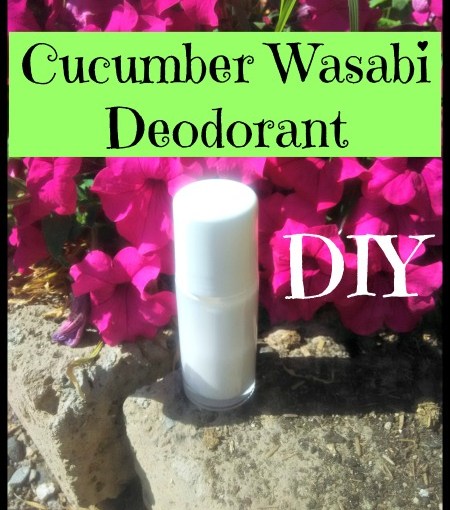
DIY Cucumber Wasabi Deodorant

LAB NOTES & SAFETY NOTICE
For educational purposes only. Content reflects personal, non-professional formulation experiments and is not instructional.
No formula or information on this site is intended for commercial use, consumer application, or third-party use.
Accessing this content means you accept all risks and full responsibility for safety, testing, legal compliance, and outcomes.
[Full Legal Disclaimer & Safety Requirements]
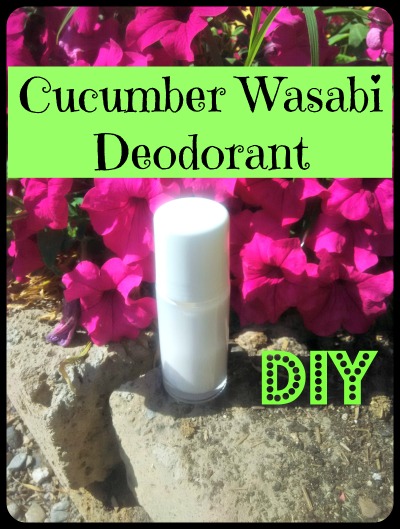
Cucumber Wasabi Deodorant 2

Hello Hello! 😀 Today I am experimenting making something a bit… unusual. Yes, I am putting Wasabi in a deodorant!

The Secret Science:

I used Wasabi Extract (Wasabia Japonica) because it should be naturally antimicrobial, but I also added Triethyl Citrate. Here’s the trick: Bacteria under your arms try to eat your sweat and turn it into stinky fatty acids. But Triethyl Citrate “tricks” them—the bacteria eat it instead, and it lowers the pH so the “stink-makers” can’t grow. It’s so smart! yeheee!

The Formula:

Phase A:

  • Water to 100
  • Glycerin 2
  • Xanthan Gum 0.5 (To make it a nice “roll-on” gel texture)

Phase B:

  • Alcohol Denat. (96°) – 15 (This helps it dry fast and kills bacteria on contact. It can be lowered to 10%.)
  • Triethyl Citrate – 5 (the “stink-stopper” hero!)
  • Wasabi Extract – 2 (The antimicrobial star!)
  • Polysorbate 20 – 2 (This is the solubilizer—it helps the “oily” parts mix into the water phase.)

Phase C:

  • Zinc Ricinoleate – 2 (This literally “traps” odor molecules like a cage!)
  • Preservative (According to your type)
  • Essential Oils – 10 drops (I used Lemon and Eucalyptus for that super fresh, clean feeling!)

Notes from the Beaker:

  1. The Mix: I mixed the Xanthan Gum into the water first until I had a smooth, clear gel.
  2. The Alcohol Trick: I mixed the essential oils and the Triethyl Citrate into the Alcohol/Polysorbate first. This ensures you don’t get oily droplets floating on top of your water!
  3. The Smell: The Wasabi extract I use is very mild, and once I added the Lemon and Eucalyptus, it just smelled incredibly fresh!
  4. pH Check: I wanted it to be around pH 4.5 to 5. Most armpit bacteria hate acidity, so keeping it low helps the deodorant work even better!

Final Verdict: This is a life-saver for summer. It’s fresh, it’s liquid, and it doesn’t leave white marks on your favorite black t-shirt. It’s my “secret weapon” against the heat! ENJOY! 😀

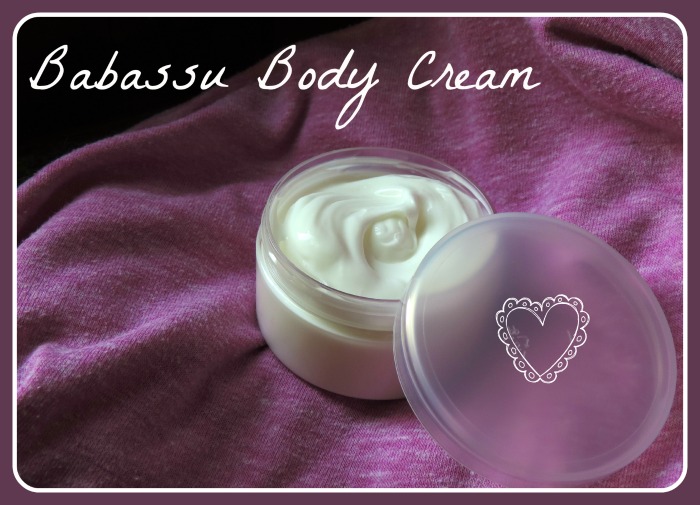
Babassu Body Cream – Recipe

LAB NOTES & SAFETY NOTICE
For educational purposes only. Content reflects personal, non-professional formulation experiments and is not instructional.
No formula or information on this site is intended for commercial use, consumer application, or third-party use.
Accessing this content means you accept all risks and full responsibility for safety, testing, legal compliance, and outcomes.
[Full Legal Disclaimer & Safety Requirements]

Hello there! 😀

Babassu Body Cream

Lab Note: My “Smooth as Silk” Babassu & Shea Body Cream

Today I’m sharing a recipe for a rich body cream using a new emulsifier: Methyl Glucose Distearate. I’ve found the skin feel is even lighter than the “Sesquistearate” version, so I might start testing this for face creams too! yeheee!

For this body cream, I wanted it to feel luxurious but not greasy, so I chose Babassu Oil and Shea Butter, but balanced them with Dicaprylyl Ether to give it a nice “dry” finish.

The “Secret” Allantoin Trick:

I add Allantoin to almost everything because it’s so soothing and affordable. But it can be tricky to disperse! My secret? I found that it “melts” perfectly into Hydrolyzed Proteins. Now, I always pair them together in my Phase C—no more grainy creams! 😉

The Formula I Used:

Phase A (The Gel Base):

  • Water: to 100

  • Glycerin: 5.0

  • Xanthan Gum: 0.2

  • Carbopol Ultrez 21: 0.4 (The “No-Stir” superstar!)

Phase B (The Precious Fats):

  • Methyl Glucose Distearate: 3.5 (The new emulsifier)

  • Cetyl Alcohol / Cetyl Palmitate: 0.8 / 0.7 (My thickening duo)

  • Shea Butter: 6.0

  • Babassu Oil: 8.0

  • Rose Hip Oil: 3.0

  • Dicaprylyl Ether: 3.0 (For that “dry” touch)

Phase C (The Active Finish):

  • Hydrolyzed Oat Proteins: 3.0

  • Allantoin: 0.4 (Pre-mixed into the proteins!)

  • Preservative (Cosgard): 1.0

  • Fragrance Oil: A few drops


Notes from my Beaker:

  1. The Carbopol Ritual: I measured the Carbopol Ultrez 21 and just poured it on top of the water. Do not mix it! Just let it sit and hydrate slowly while it sits on the surface. After a few minutes, it looks like water with little whitish pieces—that’s perfect! It only becomes a gel once the pH hits 5.

  2. The Emulsion: I heated Phase A and B to 70°C. I added the Xanthan-glycerin slurry to the water just before mixing. Then, I slowly poured Phase B into Phase A while stirring with a spatula.

  3. The Mixer: Once they are combined, it’s time for the immersion mixer! It turns white and liquid, but the mixer is what makes the “magic” emulsification happen.

  4. The Ice Bath: You cannot skip the cooling process or it might separate! I used an ice bath to speed things up, stirring for about 30 minutes until it reached room temperature.

  5. The Finish: I added my Phase C (with my Allantoin-Protein mix!), checked the pH, and adjusted it to 5.5.

  6. The Waiting Game: Because of the Cetyl Alcohol and Palmitate, the cream keeps thickening for 24-48 hours. I left it in the beaker covered with plastic wrap for two days, stirring it every now and then, before finally putting it into jars.

Final Verdict: The texture is lovely! It’s rich because of the Shea and Babassu, but the new emulsifier and the Dicaprylyl Ether keep it from feeling “heavy.” And thanks to the protein trick, the Allantoin is perfectly smooth. ENJOY! 😀 😀 😀

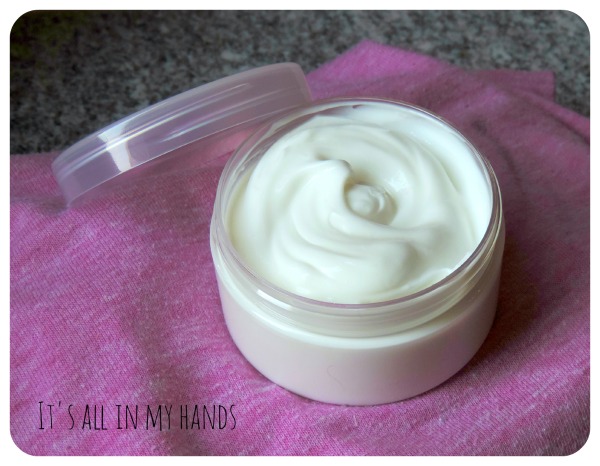
Body cream itsallinmyhands


Pink Sugar Frosting Body Lotion (Recipe)

LAB NOTES & SAFETY NOTICE
These are personal experiments for educational use only— not instructions and not for commercial or consumer use. By proceeding, you assume all risks related to safety, testing, and regulatory compliance.
[Full Legal Disclaimer & Safety Requirements]

DSCF3571

Silk-Touch Body Cream

Hello Hello! 😀 My goal for this one was to make a super emollient cream—the kind that feels really luxurious on the skin. I didn’t want to pack it with a million actives; I just wanted it to do good for the body! We spend so much time on our faces, but our body skin deserves some love too, right? 😉

The “Grease-Fall” (My Oil Selection):

Since this is for the body, I wasn’t worried about oils being comedogenic. I used 5% Shea Butter (which is comedogenic, whatever you read online! :P) because it is absolute heaven for body skin.

For the rest, I created a “Grease-Fall” using light and extra light oils. Most of these are synthetic or waxes (like Jojoba) because they make the cream feel so much better on the skin. If you want only natural oils, it won’t feel quite as silky, but Jojoba gets you pretty close!

The Formula:

Phase A:

  • Water to 100

  • Glycerin 5

  • Carbopol Ultrez 21 – 0.1 (A little gelling agent to keep it bouncy!)

Phase B (The “No-Heat” Emulsifier):

  • Abil Care 85 – 2 (This is a silicone-based emulsifier. I don’t use it on my face because it gives me tiny pimples, but for the body? I totally enjoy it! It makes the cream velvety and it’s almost impossible to fail with it! :D)

  • Tinovis ADE – 1.5 (This is the thickener/gel maker that works at room temperature—no heating needed, yeheee!)

  • Shea Butter – 5

  • Safflower Oil – 3

  • Borage Oil – 3

  • Jojoba Oil – 5

  • Dicaprylyl Ether – 5 (Extra light synthetic oil)

  • Cetiol Sensoft – 5 (The lightest oil ever—it feels like silicone but it isn’t!)

  • Tocopherol – 1 (Vitamin E)

Phase C (The Actives):

  • Allantoin – 0.35

  • Oat Hydrolyzed Proteins – 1.65 * Panthenol – 1 (Vitamin B5)

  • Preservative (The amount needed for yours!)

  • Fragrance Oil (I used “Pink Sugar” from Gracefruit… mmm! :D)


Notes from the Beaker:

  1. The Allantoin Hack: Allantoin can be a pain to dissolve—it gets gritty! But I found a trick: if you mix it with the hydrolyzed proteins first, it melts in so fast! That does the trick every time! 😀

  2. No Double Boiler: Since I used Abil Care 85 and Tinovis ADE, I didn’t have to heat anything up! It’s a fast way to get a professional texture.

  3. Mixing: I just poured Phase A into Phase B and mixed. It gets thick and silky almost instantly.

  4. Substitution Note: If you swap the emulsifier for one that does need heat, you have to move the Tinovis to Phase C because it hates heat!

Final Verdict: I am so satisfied with the “Silk-Touch” on this one. It’s emollient without being a sticky mess. ENJOY!!! 😀