LAB NOTES & SAFETY NOTICE
For educational purposes only. Content reflects personal, non-professional formulation experiments and is not instructional.
No formula or information on this site is intended for commercial use, consumer application, or third-party use.
Accessing this content means you accept all risks and full responsibility for safety, testing, legal compliance, and outcomes.
[Full Legal Disclaimer & Safety Requirements]
Hello there! 😀
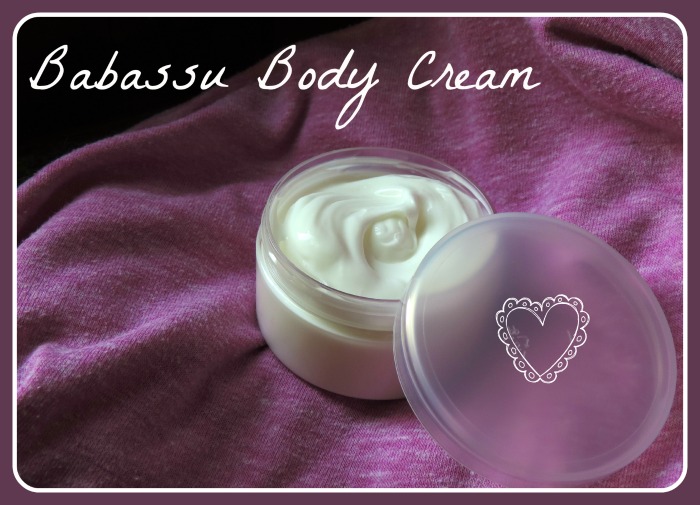
Lab Note: My “Smooth as Silk” Babassu & Shea Body Cream
Today I’m sharing a recipe for a rich body cream using a new emulsifier: Methyl Glucose Distearate. I’ve found the skin feel is even lighter than the “Sesquistearate” version, so I might start testing this for face creams too! yeheee!
For this body cream, I wanted it to feel luxurious but not greasy, so I chose Babassu Oil and Shea Butter, but balanced them with Dicaprylyl Ether to give it a nice “dry” finish.
The “Secret” Allantoin Trick:
I add Allantoin to almost everything because it’s so soothing and affordable. But it can be tricky to disperse! My secret? I found that it “melts” perfectly into Hydrolyzed Proteins. Now, I always pair them together in my Phase C—no more grainy creams! 😉
The Formula I Used:
Phase A (The Gel Base):
-
Water: to 100
-
Glycerin: 5.0
-
Xanthan Gum: 0.2
-
Carbopol Ultrez 21: 0.4 (The “No-Stir” superstar!)
Phase B (The Precious Fats):
-
Methyl Glucose Distearate: 3.5 (The new emulsifier)
-
Cetyl Alcohol / Cetyl Palmitate: 0.8 / 0.7 (My thickening duo)
-
Shea Butter: 6.0
-
Babassu Oil: 8.0
-
Rose Hip Oil: 3.0
-
Dicaprylyl Ether: 3.0 (For that “dry” touch)
Phase C (The Active Finish):
-
Hydrolyzed Oat Proteins: 3.0
-
Allantoin: 0.4 (Pre-mixed into the proteins!)
-
Preservative (Cosgard): 1.0
-
Fragrance Oil: A few drops
Notes from my Beaker:
-
The Carbopol Ritual: I measured the Carbopol Ultrez 21 and just poured it on top of the water. Do not mix it! Just let it sit and hydrate slowly while it sits on the surface. After a few minutes, it looks like water with little whitish pieces—that’s perfect! It only becomes a gel once the pH hits 5.
-
The Emulsion: I heated Phase A and B to 70°C. I added the Xanthan-glycerin slurry to the water just before mixing. Then, I slowly poured Phase B into Phase A while stirring with a spatula.
-
The Mixer: Once they are combined, it’s time for the immersion mixer! It turns white and liquid, but the mixer is what makes the “magic” emulsification happen.
-
The Ice Bath: You cannot skip the cooling process or it might separate! I used an ice bath to speed things up, stirring for about 30 minutes until it reached room temperature.
-
The Finish: I added my Phase C (with my Allantoin-Protein mix!), checked the pH, and adjusted it to 5.5.
-
The Waiting Game: Because of the Cetyl Alcohol and Palmitate, the cream keeps thickening for 24-48 hours. I left it in the beaker covered with plastic wrap for two days, stirring it every now and then, before finally putting it into jars.
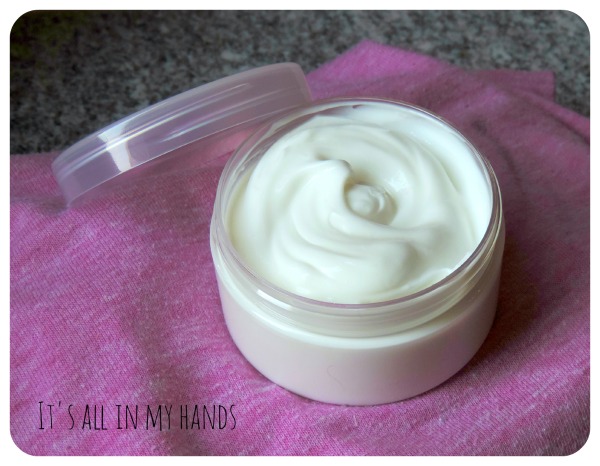
Final Verdict: The texture is lovely! It’s rich because of the Shea and Babassu, but the new emulsifier and the Dicaprylyl Ether keep it from feeling “heavy.” And thanks to the protein trick, the Allantoin is perfectly smooth. ENJOY! 😀 😀 😀


How do you check the ph?
LikeLike
Hi Lauren.
There are strips to test the pH as well as tools (usually more precise).
If you use the strips, buy those which are the most accurate: each strip has 4 different sections that react differently.
LikeLike
What unit of measurement are you using in your recipe? Grams? Milliliters? Water to 100 what? 5 what of glycerin? And so on. Seems like some are written as percentages but it is very confusing to follow this recipe without having those specifics. Please explain.
LikeLike
You can look at it as percentages or grams or kilograms or milligrams… as long as it is a weight measurement and it keeps the proportions, nothing changes 😉
LikeLike
I really want to try to make your body cream! I have checked the list ingredients you have used in all 3 body cream recipes, turns out I can’t get most emulsifiers and most water phase ingredients! I have checked out your post on suppliers, googled, and checked eBay. Most DIY supply shops are only interested in selling ‘natural ingredients’, so frustrating!!
So far I can’t find Carbopol Ultrez 21, Methil Glucose Distearate, Cetyl Palmitate, Dicaprylyl Ether, Hydrolized Oat Proteins (I did see Hydrolized Oat, are they the same thing?). Is it possible to replace them or do you know any international sellers selling them for a reasonable price and shipping charge (I’m located in Australia)?
And what preservative do you use? So far I found no Australian DIY shops selling those, all I can find are common wax and oils.
LikeLike
Hello Christina!
You don’t have to strictly stick to my emulsifiers! There are many different emulsifiers you could use, what is going to change is the texture of the cream but that’s ok.
Since you are just beginning, it is good to try different emulsifiers!
Also, to be honest, I didn’t like working with methyl glucose DISTEARATE, while I really love methyl glucose sesquistearate! Usually it is sold under the short form of MGS!
If something is called “hydrolyzed oat”, it should be proteins indeed… But do check the INCI of it! However, you can substitute it with close to ANY other hydrolyzed protein (rice, soy, grain… There are so many on the market nowadays!).
Sorry I don’t know which sell to Australia. I know most websites I wrote DO ship worldwide, but it might be really expensive once it reaches you.
Did you check Bulkactives? It should be a little closer to you and it used to have some ingredients I could only dream of (but if I remember right it wasn’t very cheap).
Sorry I couldn’t be more helpful!
LikeLiked by 1 person
Thank you very much for the detailed reply. It would be much more helpful for me to get both of the trade name and product name as they can be confusing! Another thing I need to learn is preservative, I wonder what preservative do you use? Most Australian DIY shops don’t seem to sell them 😦
LikeLike
I don’t write the trade name cause each company/reseller can change it and use their own trade name so you ALWAYS have to check the INCI of a product.
I make you an example: sometimes I am really tempted to buy active ingredients that primise to change the skin (I am ALWAYS tempted), however, once I read the INCI all my hopes go down and I am ok at not purchasing, cause sometimes these ingredients are called “super hydration booster” or “pores minimizer” and what they are is nothing else but whater, glycerin and some laughable amount of some plant extract.
So always always always learn to check the INCI before you check anything else! 😉 You will save a lot of money too!!!
Right now for creams the preservative I use is: INCI: “phenoxyethanol, ethylhexylglycerin” these two come already combined in the preservative I buy. No idea if it is easy to purchase for you though, but check makincosmetics website, she has posted a very interesting list of preservatives which are good to use and those which are not good. I have promised a post about preservatives but I would most likely write close to what she has, so you can go ahead and read there 🙂
LikeLike
Totally agree, that’s also the reason I don’t follow new lines/products. I don’t know if you are still buying skincare, but I only buy skincare from discount websites where I can get 40%-60% (sometimes could be even more!) off retail prices. At this point, I don’t really see myself making more than lip scrub, lip balm, and maybe body cream if I can get everything I needed.
I didn’t know what INCI is till very recently, I’d better check it out!
LikeLike
I still purchase but not expensive creams, I purchase when I find a good smell that I cannot find myself, or when I want a cream with a texture I am interested in 🙂 I just don’t spend too much on cosmetics anymore
LikeLike
So I used this emulsifier for my body cream, love the feel but I think its quite soft as a body cream but makes an awesome face cream. What other emulsifier would u advice for a body lotion or emulsified body butter. Thank you and keep up the good work.
LikeLike
The emulsifier makes part of the feel, but a bigger role is made by your “grease fall”. You might want to increase butters and oils for a richer cream and increase the emulsifier accordingly.
LikeLike
Please i need your expert advice on this please.. If using an AHA and BHA toner on the face, can i still use a Niacinamide cream on the face after or ………….. I ask because both are of different ph but in different product. Would they interfere on the skin?Thanks
LikeLike
I wouldn’t risk it! Niacinamide could get nasty on your skin 😉
LikeLike
Thank you so much.Glad i asked. What would be your advice.
LikeLike
Hello , i dont know if my reply came through yesterday but what would be your Advice of cream to make after using AHA and BHA toner. Thank you
LikeLike
One without niacinamide or any ingredient that will become nasty at low pH! 😉
LikeLike
Thank you
LikeLiked by 1 person
Hi, I was looking for an example of how you use carbomer in a lotion or cream and this is the only formulation I found that contains it. May I ask, when you use carbomer do you not need to neutralise it with an alcaline solution for it to transform into a gel? Or is that not necessary when it’s part of a lotion like this one? Thank you.
LikeLike
This carbomer is good at 5.5 so you will need to adjust the pH to make the gel form.
You have two choices:
form the gel when you add the carbomer to the water
OR
form it when you have already emulsified as well (in this case you have to disperse the carbomer in water first and let it hydrate as much as possible).
The first option forms a beautiful gel BUT once you add other ingredients there is the risk of ruining the gel by adding something which changes the pH.
The second option is what I do here, adjusting the pH at the end helps stabilizing the formula. You won’t see the beautiful carbomer gel, but there is less risk of spoiling the formula.
LikeLiked by 1 person