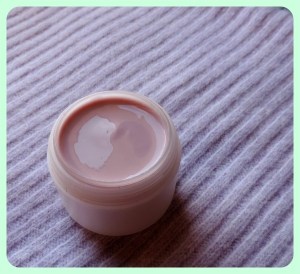
Pink Sugar Frosting Body Lotion (Recipe)

LAB NOTES & SAFETY NOTICE
These are personal experiments for educational use only— not instructions and not for commercial or consumer use. By proceeding, you assume all risks related to safety, testing, and regulatory compliance.
[Full Legal Disclaimer & Safety Requirements]

DSCF3571

Silk-Touch Body Cream

Hello Hello! 😀 My goal for this one was to make a super emollient cream—the kind that feels really luxurious on the skin. I didn’t want to pack it with a million actives; I just wanted it to do good for the body! We spend so much time on our faces, but our body skin deserves some love too, right? 😉

The “Grease-Fall” (My Oil Selection):

Since this is for the body, I wasn’t worried about oils being comedogenic. I used 5% Shea Butter (which is comedogenic, whatever you read online! :P) because it is absolute heaven for body skin.

For the rest, I created a “Grease-Fall” using light and extra light oils. Most of these are synthetic or waxes (like Jojoba) because they make the cream feel so much better on the skin. If you want only natural oils, it won’t feel quite as silky, but Jojoba gets you pretty close!

The Formula:

Phase A:

  • Water to 100

  • Glycerin 5

  • Carbopol Ultrez 21 – 0.1 (A little gelling agent to keep it bouncy!)

Phase B (The “No-Heat” Emulsifier):

  • Abil Care 85 – 2 (This is a silicone-based emulsifier. I don’t use it on my face because it gives me tiny pimples, but for the body? I totally enjoy it! It makes the cream velvety and it’s almost impossible to fail with it! :D)

  • Tinovis ADE – 1.5 (This is the thickener/gel maker that works at room temperature—no heating needed, yeheee!)

  • Shea Butter – 5

  • Safflower Oil – 3

  • Borage Oil – 3

  • Jojoba Oil – 5

  • Dicaprylyl Ether – 5 (Extra light synthetic oil)

  • Cetiol Sensoft – 5 (The lightest oil ever—it feels like silicone but it isn’t!)

  • Tocopherol – 1 (Vitamin E)

Phase C (The Actives):

  • Allantoin – 0.35

  • Oat Hydrolyzed Proteins – 1.65 * Panthenol – 1 (Vitamin B5)

  • Preservative (The amount needed for yours!)

  • Fragrance Oil (I used “Pink Sugar” from Gracefruit… mmm! :D)


Notes from the Beaker:

  1. The Allantoin Hack: Allantoin can be a pain to dissolve—it gets gritty! But I found a trick: if you mix it with the hydrolyzed proteins first, it melts in so fast! That does the trick every time! 😀

  2. No Double Boiler: Since I used Abil Care 85 and Tinovis ADE, I didn’t have to heat anything up! It’s a fast way to get a professional texture.

  3. Mixing: I just poured Phase A into Phase B and mixed. It gets thick and silky almost instantly.

  4. Substitution Note: If you swap the emulsifier for one that does need heat, you have to move the Tinovis to Phase C because it hates heat!

Final Verdict: I am so satisfied with the “Silk-Touch” on this one. It’s emollient without being a sticky mess. ENJOY!!! 😀

Formulating a lotion: Choosing the fats – THEORY pt.5

LAB NOTES & SAFETY NOTICE
For educational purposes only. Content reflects personal, non-professional formulation experiments and is not instructional.
No formula or information on this site is intended for commercial use, consumer application, or third-party use.
Accessing this content means you accept all risks and full responsibility for safety, testing, legal compliance, and outcomes.
[Full Legal Disclaimer & Safety Requirements]

My Lab Diary: The “Grease-Fall” (A Study in Balance)

Hello Hello! 😀

Today I want to talk about something very important when we make a cream: the Grease-Fall. I’ve been doing a lot of experiments lately because I wanted to understand why some of my creams felt “greasy” on my skin for a long time, while others disappeared too fast and my skin felt dry again.

I found out it’s all about the spreading velocity of the oils we use!

What is the Grease-Fall? Think of it like a waterfall of oils. If you only use one oil, like Olive Oil, it has one “speed.” But if you mix different oils, you can make a “cascade” where the skin feels good from the first second until many hours later.

In my lab notes, I divide my oils into three groups:

  1. Light Oils (The fast ones!): These are oils that spread very quickly. When you put the cream on, these are the ones that make it feel “silk” and not “fat.” I like to use things like Cetiol Sensoft or Dicaprylyl Ether.

  2. Medium Oils: These are the heart of the cream. They spread a bit slower than the light ones. Here I use my favorites like Argan oil, Jojoba, or Caprylic/Capric Triglycerides.

  3. Heavy Oils and Butters: These are the slow ones. They stay on top of the skin to protect it so the water doesn’t evaporate. Here I put my Shea Butter, Cocoa Butter, or Castor oil.

How I make my “Team of Oils”: I don’t just pick an oil because the marketing says it’s “miraculous.” (I don’t believe in miracles, I believe in INCI! 😉 ) I try to make a balance. For example, if I use 10% of oils in my cream, I don’t use 10% of Shea Butter. That would be like wearing a plastic mask!

I try to do something like this:

  • 3% Light oils

  • 4% Medium oils

  • 3% Heavy oils/butters

This way, the effect of rubbing the cream should be something like this :

  • First, the Light oils spread and it feels “Wow, so smooth!”

  • Then, the Medium oils take over.

  • At the end, the Heavy oils stay to protect the skin.

This is the secret to a professional cream! It’s not about the most expensive oil in the world, it’s about how you mix them.

It’s all in my hands! 😉

HAVE A GREAT DAY! 😄

How to make a lotion – THEORY pt.1

LAB NOTES & SAFETY NOTICE
For educational purposes only. Content reflects personal, non-professional formulation experiments and is not instructional.
No formula or information on this site is intended for commercial use, consumer application, or third-party use.
Accessing this content means you accept all risks and full responsibility for safety, testing, legal compliance, and outcomes.
[Full Legal Disclaimer & Safety Requirements]

Escin and Caffeine Eye Cream14

My Lab Notes: The Four Pillars of a Great Emulsion

Hello Hello! 😀

When I first started playing with body butters, I realized pretty quickly that I needed to dig a bit deeper into the science of it all. I didn’t want to just follow “recipes”; I wanted to understand the why.

These are my personal notes on the core structure of every face and body cream I make. While formulation can get incredibly complex, I’ve realized that my most successful experiments always come down to these four essential pillars.

1. The Mechanics of Hydration (Water + Fats)

I used to think water was just a filler, but it’s actually the hydration hero! The problem is that water evaporates too fast on its own. That’s where the Lipids (my oils and butters) come in—they act as a shield to keep that moisture trapped in.

  • My Observation: I’ve noticed that an emulsified cream (where the water and oil are actually “glued” together) works so much better than just shaking up a bottle of oil and water. It feels better, and the skin stays hydrated longer!

2. Preservation: My Non-Negotiable Rule! 😀

PHEW! Let’s talk about preservatives. I know some people want to avoid them, but in my lab, preservation is NOT optional. * The Reality: Any time I add water to a formula, I’m basically inviting bacteria and mold to a party. Unless I want to keep my creams in the fridge and throw them away after three days (no thanks! 😉 ), I need a professional preservation system. I usually choose eco-friendly options around 0.5-1%. Safety first!

3. The Water Phase: Pure vs. “Poetic”

For my experiments, I always use demineralized, pure water to avoid any minerals messing with my emulsifiers.

  • A bit of Poetry: I love using Rose water or Witch Hazel, but I’ve started categorizing these as “poetic” ingredients. They smell amazing and feel luxurious, but I keep my expectations realistic—they are there for the soul of the cream, while the “active ingredients” do the heavy lifting!

4. The Lipid Phase: Balancing the “Fall”

I’ve stopped believing in “miracle oils.” Now, I focus on the Grease-Fall.

  • The Strategy: Instead of just picking one oil, I look at the density ($\rho$) and the viscosity. I want a blend of light, medium, and heavy fats so the cream feels balanced from the moment I put it on until it sinks in.

5. Emulsifiers: The Architecture

The emulsifier is the “bridge” that holds the whole thing together. I choose mine based on:

  • Temperature: Do I want a cozy hot-process session at 70°C, or a quick cold-process fluid?

  • The “Touch”: Some give a dry, powdery finish, while others feel rich and velvety.

These four pillars are the foundation of everything I do. Once I get these right, I can start playing with the fun stuff—the actives!

HAVE A GREAT DAY! 😄