Water in Cosmetic DIYs

LAB NOTES & SAFETY NOTICE
For educational purposes only. Content reflects personal, non-professional formulation experiments and is not instructional.
No formula or information on this site is intended for commercial use, consumer application, or third-party use.
Accessing this content means you accept all risks and full responsibility for safety, testing, legal compliance, and outcomes.
[Full Legal Disclaimer & Safety Requirements]

Hello Everybody! 🙂

Today I will briefly talk about the water I use in my Formulations and how I calculate its amount (I have received many questions of explanation 🙂 I thought it was clear but apparently it was not so).

Water

Whenever I use water in my formulas, I need to add preservative because where there is water, there is life and therefore bacteria and mold of any sort might be enjoying the swimming pool 😀
To be really thourough, bacteria or mold can actually be even in powder form cosmetics but this doesn’t change the fact that if there is water, there needs to be a preserving system in place because for sure there will be possible bacterial and mold growth.

But the real question is: is ANY WATER the same for use in cosmetic ingredients?
And well, the answer is: ABSOLUTELY NOT.

KEEP ON READING

Silicones in cosmetics – the truth

LAB NOTES & SAFETY NOTICE
For educational purposes only. Content reflects personal, non-professional formulation experiments and is not instructional.
No formula or information on this site is intended for commercial use, consumer application, or third-party use.
Accessing this content means you accept all risks and full responsibility for safety, testing, legal compliance, and outcomes.
[Full Legal Disclaimer & Safety Requirements]

Hello there! 🙂

Today I want to talk about SILICONES because I found there is so much mis-knowledge about them online and I felt I need to clear their reputation a little. 🙂
Obviously everybody is entitled to have their own opinion… BUT, to have a real opinion, one is supposed to have a real notion of what they are talking about 😉 so here I try to sum up some facts that might have created confusion.

Silicones
KEEP ON READING

Sulfur Mask – for acne and oily skin

LAB NOTES & SAFETY NOTICE
For educational purposes only. Content reflects personal, non-professional formulation experiments and is not instructional.
No formula or information on this site is intended for commercial use, consumer application, or third-party use.
Accessing this content means you accept all risks and full responsibility for safety, testing, legal compliance, and outcomes.
[Full Legal Disclaimer & Safety Requirements]

Hello there! 😀

The recipe of today is for an acneic skin or very oily skin, it is, in fact, a recipe for a mask that will really help control the oiliness and will help dry up the pimples much faster! 🙂

Sulfur Mask DIY

I loved the idea of combining zinc oxide (which has great soothing properties – but leaves the face quite “white” and therefore it is great in a mask that can be washed off) and sulfur (you already know that it is good against acne and oily skin! 😀 ). It could be a good idea to add some salicylic acid (0.5% should be enough) but since I was going to use this mask in spring/summer I preferred not to add any (acids are never a good combination with possible sun exposure).
KEEP ON READING

Caffeine & Escin Eye Cream DIY

LAB NOTES & SAFETY NOTICE
For educational purposes only. Content reflects personal, non-professional formulation experiments and is not instructional.
No formula or information on this site is intended for commercial use, consumer application, or third-party use.
Accessing this content means you accept all risks and full responsibility for safety, testing, legal compliance, and outcomes.
[Full Legal Disclaimer & Safety Requirements]

Hello there! 🙂

This new recipe for an Eye-Cream for my blue circles and puffiness. I felt it did help a little (even though cosmetics are never magic potions).
I am really satisfied!

Escin and Caffeine Eye Cream

I wrote “blue circles” and not the more generic “dark circles” because there are two different kinds of dark circles:
KEEP ON READING

Hyaluronic Acid Serum for Problem Skin

LAB NOTES & SAFETY NOTICE
For educational purposes only. Content reflects personal, non-professional formulation experiments and is not instructional.
No formula or information on this site is intended for commercial use, consumer application, or third-party use.
Accessing this content means you accept all risks and full responsibility for safety, testing, legal compliance, and outcomes.
[Full Legal Disclaimer & Safety Requirements]

Hello there! 😀

Hyaluronic Acid Serum for Problem Skin

Today I am back with a recipe for an extremely simple yet effective serum… however there are a couple of things I need to say first!
1) This serum is formulated to help a problematic skin. With this I intend a skin which suffers of mild blemishes every now and then, maybe a little irritated and with a few red marks left by previous spots, add an oily T-zone… and that should be it 😀 . The ingredients of this serum will HELP the skin keep hydrated, will help keeping the oiliness under control and will help to soothe the skin (it might also have some effect against the red marks). Obviously, this serum is NOT A CURE for acne or for serious conditions: it is just a help. I want to underline this because too often, online, we read about “the final cure for blablablaaa” but this is not the case 😀

So here is the Serum FORMULA:

KEEP ON READING

Fructose Face Wash

LAB NOTES & SAFETY NOTICE
For educational purposes only. Content reflects personal, non-professional formulation experiments and is not instructional.
No formula or information on this site is intended for commercial use, consumer application, or third-party use.
Accessing this content means you accept all risks and full responsibility for safety, testing, legal compliance, and outcomes.
[Full Legal Disclaimer & Safety Requirements]

Hello there! 😀
I made a little experiment.
Well, this is a recipe for a very very delicate face wash 😉

fructose8

I decided to try an preserve this detergent with… SUGAR?!
Sugar at low concentration is very loved by bacteria, BUT at very high concentration (at minimum 35%) it actually “occupies” the water molecules and doesn’t let bacteria grow (IMPORTANT: this is not a suggestion to preserve your cosmetics with sugar, this is just my experiment for a theoretical idea).
I use FRUCTOSE in this recipe simply because it feels the best on the skin (it makes the detergent feel very silky and smooth), while other kinds of sugars don’t make the same effect.
Another good news about using sugar in the detergent is that it actually makes the detergent much milder and thicker! 😀

KEEP ON READING

Can you recognize a good Shampoo pt.4

LAB NOTES & SAFETY NOTICE
For educational purposes only. Content reflects personal, non-professional formulation experiments and is not instructional.
No formula or information on this site is intended for commercial use, consumer application, or third-party use.
Accessing this content means you accept all risks and full responsibility for safety, testing, legal compliance, and outcomes.
[Full Legal Disclaimer & Safety Requirements]

Hello there! 😀

This is finally the last chapter of our “Recognizing a good Shampoo” topic.
We have learnt the basics of shampoo surfactants in the part 1 and part 2 and in the last post (which you can find here) we talked about the most common “extra ingredients”.
I know I haven’t covered all the possible things but I did what I could 😀
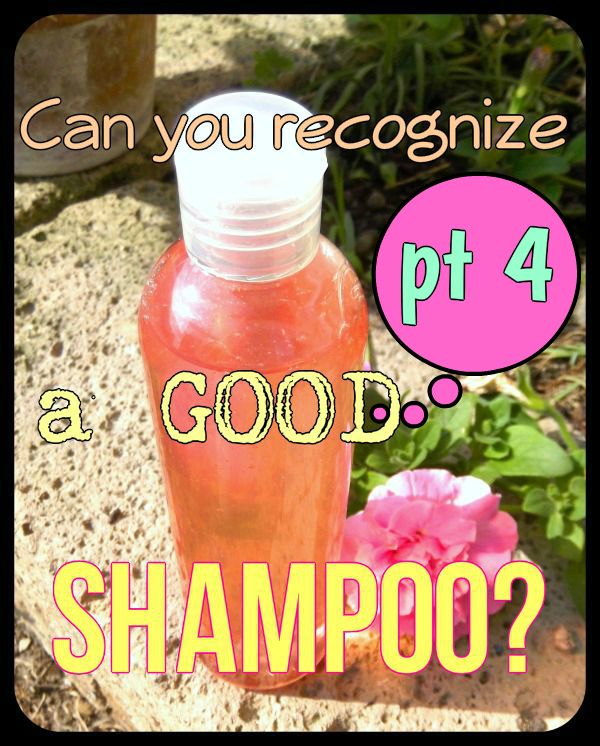
Can you recognize a good Shampoo pt 4

Today I just want to briefly talk about those “useful” ingredients which we find in our shampoos, meaning those ingredients which should (at least theoretically) make a difference! 😉

Panthenol – It derives from Vitamin B5. A famous shampoo brand made a huge campaign on their shampoos because they contain this vitamin. Yes, it is supposed to have good effect on hair and scalp, it is an humectant and it helps retain the water. It also creates a light “film” on the hair protecting them from damage. 
However, in a product like a shampoo, which we wash off after few seconds from having applied it, it might not be that effective and therefore if you find it in a shampoo it is very probably in minimal amount, just to look good in the ingredient’s list. 😉

KEEP ON READING