DIY Karma Shampoo (extra delicate!) & chat on betaine

Hello everyone! 😀

Make your own Karma Shampoo
I was already in love with a shampoo recipe but I have “upgraded” it thanks to “betaine” (this is the INCI name, but to not confuse it with surfactants we better call it Trimethylglycine or TMG).
Wikipedia says: “Trimethylglycine (TMG) is an organic compound that occurs in plants. Trimethylglycine was the first betaine discovered by science; originally it was simply called betaine because, in the 19th century, it was discovered in sugar beets”.
So what is all the fuss about this ingredient? 😀
Properties of Trimethylglycine:
In detergents, at a 5% concentration, it helps making the detergent more gentle on the skin, so in this shampoo this is why I have added it 😀
But this is definitely not all about this great ingredient: it has anti-inflamatory and soothing properties, so it is great used in creams for people with sensitive skin, it helps reaching a very creamy consistency in creams (so it is a plus for texture! 😉 ), apparently it also helps to stabilize vitamin C.
How to use it: it is used at a percentage between 2% and 5% in creams but in detergents it should be added at 5%. It is water soluble. It has a basic pH so beware if you are using it with pH sensitive ingredients (like Niacinamide for instance… which should never reach very basic pH).

KEEP ON READING

Banana Smoothie – Hair Conditioner (with Cetrimonium Chloride)

Bananasmoothie2

Hello Hello Everyone! 😀

I know I posted a recipe of a Hair Conditioner not long ago (you can check it out HERE), but I am too excited about this one to wait any longer! 😀
In the previous recipe I was using an eco-friendly emulsifier which gave me a good hair conditioner. I had also added a lot of thickening agents so it couldn’t be poured into a bottle but it needed to be put in a pot, as you can see from the picture.

This Hair Conditioner, instead, is done with a different emulsifier.
Ladies and Gentlemen please welcome Mr. Cetrimonium Chloride! 😀
It is a very good conditioner for hair, his effect lasts as long as it is still present on your hair therefore it is used very effectively in Leave-In Hair Conditioners!
This, however, won’t be a Leave-In (I am planning to formulate one soon enough anyway! 😀 So if you are interested… just keep tuned! 😀 ).

This is a creamy but not too thick Hair Conditioner, thanks to the fact that I didn’t use a high percentage of thickeners.

KEEP ON READING

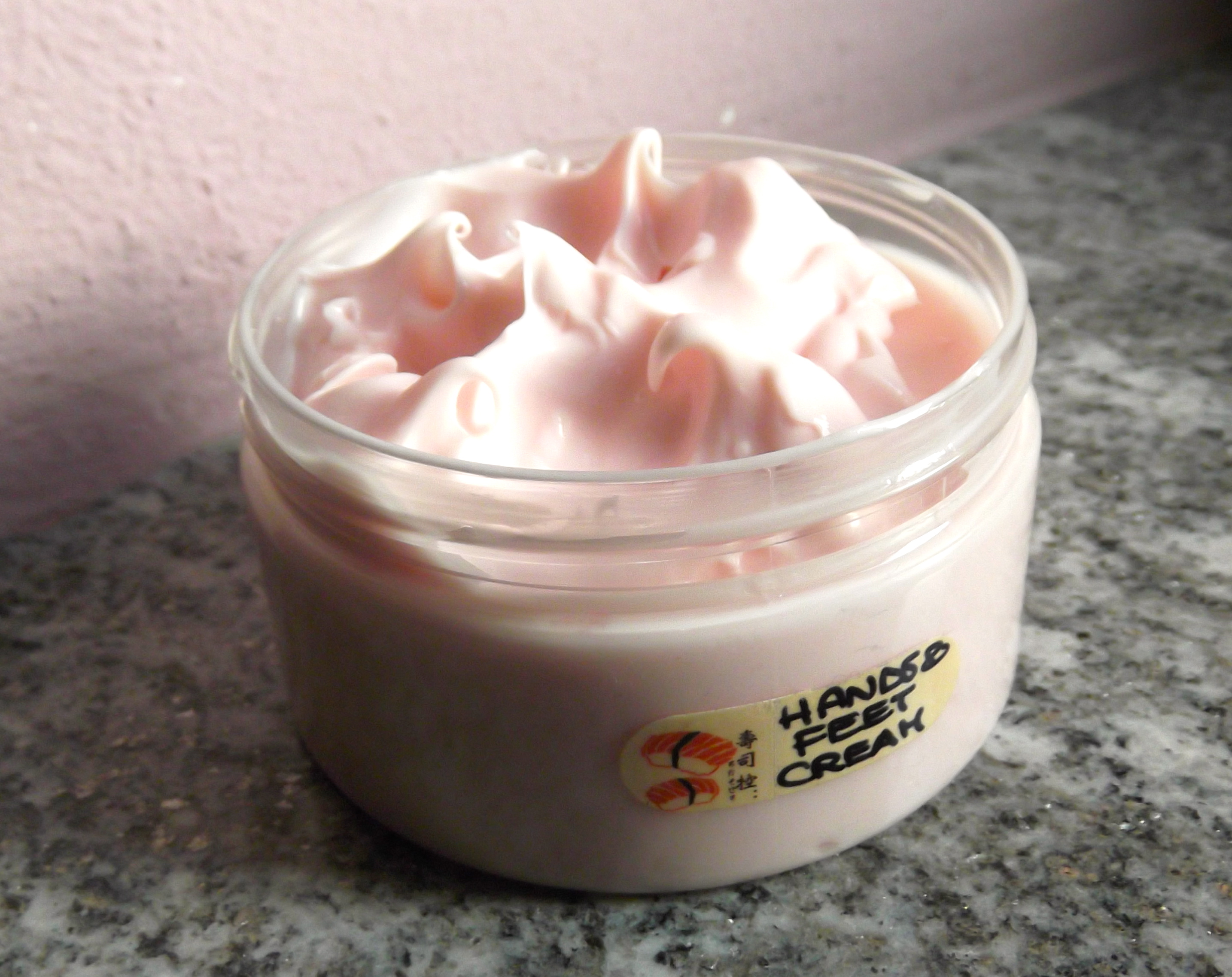
Pink Sugar Frosting Body Lotion (Recipe)

Hello everybody! 😀

Today I am going to share with you a recipe for a body cream.

DSCF3571

[If you are new to the making of lotions at home… you might want to run here! 😀
If you already know the basics but miss the ingredients you might want to read the post about where to buy cosmetic ingredients online (here!) 😀 ]

I made this cream for a good friend who just requested a good body cream for dry skin.
My intention was to get a very emollient cream (which often means “an important and well studied oily phase”) with few active ingredients to do good to the skin (we don’t want to use active ingredients only on our face: we can afford to use some also on the rest of our body 😉 ).

How I proceeded:
Picking the oils: being a body cream I wasn’t too concerned about using comedogenic oils or butters. This is why I used a 5% of Shea Butter (which, whatever you read online, is comedogenic due to its fatty acid composition… In case, you can read more about it here) without thinking twice. Shea butter is heaven for the skin of our body. As medium density oil I added Borage oil and Safflower oil, but the main part of my “Grease-Fall” was made of light and extra light oils (to be really honest Jojoba oil is a wax and the other two were synthetic oils which have the very good property of improving the feel of the cream on the skin. If you want to use only natural oils I will add options at the end of the post on how to change the recipe 😀 ).

KEEP ON READING

Aloe Vera Hair Gel – Recipe

It is over a year now that my husband uses my Aloe Vera Hair Gel and he is very happy with it, but I never thought it would be interesting to post about it… until today 🙂

The recipe is really fool-proof-easy and it makes a good hair gel, which won’t become white if you brush through your hair after it dries up, the hairs stay in shape but don’t look glued!
It is also good if you have long hair and you want to give them proteins: use it in small amount on wet hair (just after you wash them) and then dry them as you are used to. In this case it doesn’t keep the shape but makes the hair shiny and in a month or two they look much more healthy and they feel stronger 🙂 (this is my experience).

DIY Aloe Vera Hair Gel

There are three methods depending on your starting point:

Method 1: if you have Aloe Vera Juice you are going to use it instead of water (substitute the water of the recipe with the juice! 🙂 )

Method 2: if you have the concentrated Aloe Vera Powder (1:200) you will make the gel with glycerin, xanthan gum and water and then add the 0.5% Aloe Vera powder to your gel (it will melt immediately 😉 ).

Method 3: FOOL-PROOF! You can even use a bought Aloe Vera Gel (just make sure the Aloe Vera amount is at least around 95%! Run away from any “10% Aloe Vera Gel”) and add to it the other ingredients of this recipe (of course leaving out the xanthan gum, the glycerin and the water… easy no? :D). This method also works if you have your already homemade Aloe Vera Gel which you read in this post. In case the gel is too liquid, you can add a little bit of xanthan gum to have a more firm gel 😉

KEEP ON READING

How to formulate a Face Wash – with Recipe

Now that we have studied the theory of Surfactants (here and here) and we have the values of some of them it is time to finally formulate! 😀

The recipe of today is for a very delicate Face Wash which helped me when I used to suffer of a mild but annoying and constant (meaning that my skin wasn’t covered in pimples completely but I did have a few all the time and this lasted over two years) form of acne. I should make a post about this! I used to be quite aggressive with my skin: I was scrubbing, using alcoholic toners, applying aggressive creams… but nothing was helping (on the contrary…).
Then one day I decided to give a break to my skin, I stopped scrubbing crazily, I stopped attacking my skin and I started concentrating on eating more healthy food and… TADAAA it did the trick 😀 I simply found out that all my skin needed was to be treated gently.

DIY Face Wash - Recipe

This is how the formulation was done:

KEEP ON READING

On Surfactants and Formulation (face wash, shampoo and shower gels)

So now we know how to combine (and why to combine) the different surfactants… but how to calculate the Active Surfactant Matter we want in our product? (which also mean: how much surfactant we have to add to our product to have the surfactant concentration we want to obtain?).

As I already explained the Surfactant Matter of a liquid surfactant which we buy is not 100%: the surfactant is made of the Surfactant Matter and Water (and probably other ingredients like glycerin, for example); therefore every surfactant we buy has a “Active Surfactant Matter” percentage which is what we have to consider.

As I wrote in the previous posts about formulation of detergents (shampoo, bubble bath, shower gel, face wash), the amount of the TOTAL Active Matter of surfactants has to vary according to the purpose of our detergent.

Generally this is the scheme:
– face wash: <10% 
– detergent for intimate use: <10% 
– shampoo: 10%-15%
– shower gel: 15%-20% 
– bubble bath: 20%-25% (in case you really use it only to make bubbles in the bath tub and you never use it directly on your skin, you could even reach 35%… but I don’t suggest it).

Now let’s learn how to formulate the detergent.

KEEP ON READING

How to formulate a detergent – THEORY pt.2

Now we know the basics about our surfactants (if you haven’t read the previous post, go HERE) now it is time to actually formulate a detergent.

Even if you don’t plan on making the detergent by yourself, reading this might be useful to you in order to understand what’s actually inside your shampoo or other detergents and you will be able to understand if these products are delicate or not 😉

How to formulate a detergent

There are not totally wrong combinations of surfactants: you can mix them just by chance and eventually you will always get a detergent, whatever you do. What could go wrong is that you might get a very liquid detergent or you might get it more aggressive than you expected, but it will still be a detergent!
However there are some rules that, if followed, will give you a good detergent with a good density and the right washing-ability.

Controlling the DELICACY:
So far what we said is that mixing more surfactants will eventually give us a less harsh detergent (of course than a detergent made with a single surfactant keeping the active matter value stable).
We also said that when formulating, the best choice should be:
– an anionic or non-ionic surfactant; it is the surfactant which we will add in our detergent at higher %.
– an amphoteric surfactant; it will make the first surfactant more mild.
extra surfactants: (usually non-ionic) these are used in very low percentage and are added to improve the lather or the consistency of the detergent.
Making this kind of combination of surfactants will give, as a result, a balanced detergent which will be delicate enough (this is of course also related to the active matter %).

Always as a matter of delicacy, if you add certain substances, they act as a protector to your skin (for example proteins, at 1-2%).
You could also think of superfatting your detergent and this low percentage of oil will “use” some of the surfactants making your detergent more mild on the skin. Notice, however, that some surfactants don’t “bear” the presence of oils (even an extra drop of perfume oil can disturb them) and get liquid immediately after you add them to the mixture (for example it is the case of sodium lauroyl sarcosinate).

VISCOSITY:
The viscosity of your product is very important: a water-like detergent gives to our subconscious the feeling that it cannot clean enough (even if it is not so).
The negative thing is that some surfactants, when combined, give a very liquid result.
Luckily there are few combinations of surfactants which work very well in giving you a dense detergent:
– SLES + betaine (an amphoteric surfactant) + salt = very dense detergent. Sodium chloride (salt) is often in commercial detergents, even in shampoos. However if you add too much it can make your detergent too harsh. In my shampoo I use SLES, cocamidopropyl betaine and I never needed to add salt because it was dense enough (sometimes even too much).
SLS + a glucoside (this means a non-ionic surfactant: lauryl glucoside, decyl glucoside are the most common for example).
– sodium lauroyl sarcosinate + pH 5 (acidify your detergent to pH 5, using citric acid in a solution or lactic acid, and the sarcosinate will become thick)

There are also other things you can use in case your detergent is too liquid:
if you have already tried the recipe and you like the result as detergent but it is too liquid, the next time you repeat the recipe you can add xanthan gum to the water of the detergent in order to thicken it up a little bit. However do not use xanthan gum at more than 1% or the detergent will get an unpleasant slimy feeling.

There are also some synthetic thickeners exactly made for surfactants.
The best one so far is Tinovis GTC (Inci: Acrylates / Beheneth-25 Methacrylate Copolymer) because you can add it at the end of the making of your detergent and therefore you can adjust the density little by little.

Obviously if you don’t care how your detergent looks and you are fine with washing yourself with a water-liquid detergent… you can use it as it is! 🙂

Now finally to THE FORMULATION

Also the formulation of a detergent is divided in Phase A, B and usually C.

Phase A:
this will be our water phase and usually it contains water and glycerin (remember glycerin is important to keep our products hydrated, this is because glycerin is highly hydrophilic).
In case you want to add xanthan gum you have to add it now (also some synthetic thickeners have to be added in beginning so be sure to read the data sheet of your raw material in advance! 🙂 ).
You also add here any hydrophilic ingredient: for example you add your preservative (ONLY in case it is hydrophilic of course), your hydrophilic colorant (for example the food grade ones), and so on.

Phase B:
In our phase B we have most of the surfactants: usually we add the surfactant at higher percentage (which is usually an anionic surfactant) and one by one we add the “extra surfactants” which are usually the non-ionic ones.
IMPORTANT: do not add now the amphoteric surfactants (generally the betaine) or your detergent might get ruined (in the way it gets very liquid… once again: a detergent cannot really get spoiled and it will still clean your body even if you do something wrong).
Often I add the perfume and the lipophilic preservative directly here in the mixture of surfactants (of course in case I am not using already an hydrophilic one).
One important thing to notice is that once you add a surfactant to another you are supposed to mix slowly and combine them very well because you add a third one.

Now it is time to pour Phase A slowly into Phase B and mix.
This time we only use a spoon to mix, paying attention to not make too many bubbles (however even if you get too many bubbles, they will disappear with time).

Phase C:
This is the phase where you add the amphoteric surfactant and usually your detergent gets thick here.
If this doesn’t happen you can always add here your synthetic thickener (in case it is the kind that needs to be added in the end) or you can try by adding 1% salt or… once again… you can just use your detergent as it is and try to do better next time. 🙂
In case of shampoo you also are supposed to add at this moment all the hair conditioner substances (which will help your shampoo to not feel harsh on the hair)… but I will make a post specifically about hair shampoo to explain this better 😉

Next post will be a recipe for a detergent and I will also show you how to calculate the ACTIVE matter of your detergent, so stay tuned! 🙂
Have a great day! 😀


Sources 

(Sources)
Creative Commons License
This work is licensed under a Creative Commons Attribution-NonCommercial-NoDerivatives 4.0 International License.