LAB NOTES & SAFETY NOTICE
For educational purposes only. Content reflects personal, non-professional formulation experiments and is not instructional.
No formula or information on this site is intended for commercial use, consumer application, or third-party use.
Accessing this content means you accept all risks and full responsibility for safety, testing, legal compliance, and outcomes.
[Full Legal Disclaimer & Safety Requirements]
Hello there! 😀
The recipe of today is for an acneic skin or very oily skin, it is, in fact, a recipe for a mask that will really help control the oiliness and will help dry up the pimples much faster! 🙂

I loved the idea of combining zinc oxide (which has great soothing properties – but leaves the face quite “white” and therefore it is great in a mask that can be washed off) and sulfur (you already know that it is good against acne and oily skin! 😀 ). It could be a good idea to add some salicylic acid (0.5% should be enough) but since I was going to use this mask in spring/summer I preferred not to add any (acids are never a good combination with possible sun exposure).
Enough now, let’s go straight to the recipe! 😀
FORMULA:
Phase A:
Water to 100
Glycerin 2.5
Xanthan gum 0.5 (this is the gelling agent. I used the non-transparent one)
Phase B:
Methil Glucose Sesquistearate 3 (this is the emulsifier)
Cetyl Alcohol 1.5 (this is the thickening agent and co-emulsifier – I used this much because I wanted the mask to be very thick)
Zinc Oxide 10 (I used this much because I don’t mind if the mask makes my face look a bit white for 10 minutes 😀 )
Sulfur (flowers, grinded, or powder) 1
Kokum Butter 2
Shea Butter 1
Grapeseed oil 3
Tocopherol 1 (this is Vitamin E)
Phase C:
Preservative (I used Cosgard at 1%)
Safflower oil 3
Bisabolol 0.5 (this is a substance anti-irritant and anti-inflammatory properties)
D-Panthenol 1 (also known as Vitamin B-5)
This is it! 🙂
Now to the usual HOW TO:
1) I add the Xanthan Gum to the Glycerin and mix. It became very thick because I am using a lot of Xanthan gum in this formula
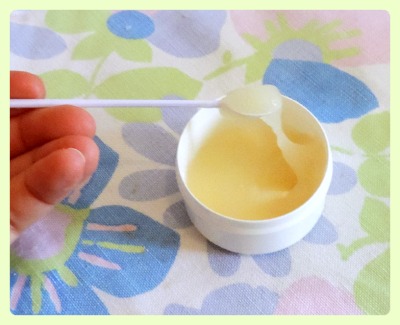
2) I add water little by little until I got a uniform smooth gel
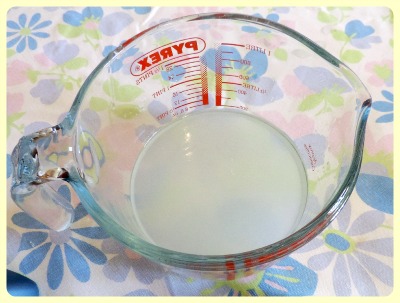
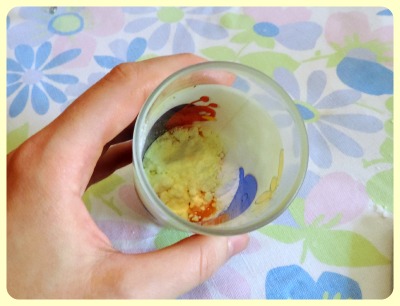
3) I measured all the ingredients of our Phase B:
the yellow thing you see is the Sulfur powder, the white on the right is the Zinc Oxide, the brown is the Tocopherol (all the other ingredients are in the bottom of the glass).
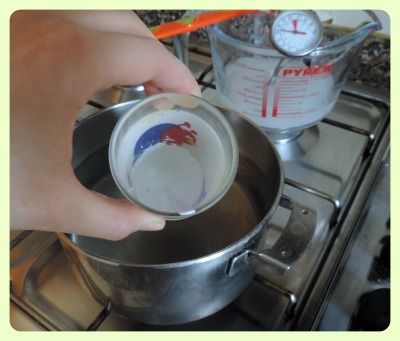
4) I heat up both Phases up to 70°C
(notice the consistency and the color of the Phase B: it is almost totally white because of the amount of Zinc Oxide)
5) When they both reach 70°C, it is time to pour the Phase B into the Phase A and mix with an immersion mixer. (I don’t have a picture of this but I have many pictures in the other recipes I have posted)
6) I keep mixing with a spatula until the temperature goes down to room temperature.
7) I then measure the Phase C (in the picture) and add it to the cream; I mix very well with the spatula.
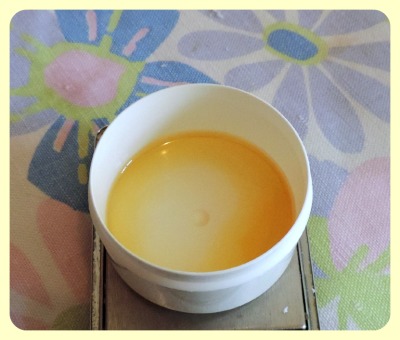
That’s it! 🙂
As easy as that! 😀
Now a couple of notes about this mask: it DID WORK. I have a medium-oily skin and this cream definitely helped me stop the oiliness.
I wouldn’t suggest this kind of cream for someone who has acne but also a dry skin because I think it would dry it too much.
I applied it for 5 minutes every few days, not every day.
NOTE about THE SMELL:
as you might have noticed I haven’t added any fragrance to this cream, and this is simply because Sulfur has already a very “special” HELL-SMELL! 😀
I am in no way a perfume expert so I had no idea how to try and hide the smell with a fragrance and that’s why I just opted for leaving this mask fragrance free: after all this is a recipe for a mask: it doesn’t have to be kept on the face for too long!

 IT'S ALL IN MY HANDS
Phase B does not list the amount of sulfur you used. Could you update that please?
LikeLike
Indeed!!! 😀
Thank you! 😀
ps. it was 1%
LikeLike
My father in law (born 1872) used to make up a similar ointment using simply flowers of sulphur and lard! It had a great local reputation.
LikeLiked by 1 person
🙂
LikeLike
this combination will cure a dogs mange infection as well as scabies genius
LikeLike
Hi.
Could I make this mask, but use kaolin, bentonite clay or any natural powder (oatmeal, activated charcoal, greentea, turmeric, garlic…..) instead of zinc oxide?
Since i dont want any oil or butter in my mask. I have combination skin and acne and the humid weather here. So last night i tried to make my own recipe.
It only has
phase A: water, glycerin, xanthan gum, carbomer 940.
Phase B: kaolin clay, bentointe clay, magiesium stearate
Phase C: herbs extract, allantoin, hydrolized milk protein, germall plus.
At last i pour a few drops of acid citric solution to adjust the pH, u know. Is it ok?
Do i have to heat it? And i realised one thing that it very difficlut to disperse clay in the water phase. Meh. I dont know if I should use it. 😂 do u have any suggest for me? Any answer will be greatly appreciated. ^^
Or Water sleeping mask? I love making facial mask and I will be verry appreciate if you write something about making it. Water sleeping mask 😋
LikeLike
It is extremely difficult to preserve anything containing water and clay!
The mask I formulated worked very well and I actually stopped using it cause it dried my skin a little too much (because of the sulfur).
If you wish to use clay and water, then the best thing you can do is to make your mask in very small quantity so you can finish it in just one application (no need to preserve it since you use it right after you make it).
Hope this helped 😉
LikeLike
what is the basic formula of making face mask
how would i formulate an anti aging face mask for oily acne prone skin
how would i formulate a face mask for different skin types
LikeLike
Face masks are nothing different to face creams. It might be a little different only if it is a clay mask, but in this case the best thing is to make it and use it up because clay is extremely difficult to preserve once it touches water.
For a face mask you simply formulate a good cream and use it as a face mask. I am not joking: there is nothing different in the formulation and manufacturing process.
LikeLike
ok
that helps
but can you also give some guide lines
for making a mask for anti aging for oily skin
LikeLike
Just make a cream with low fat % and add some active ingredients like hyaluronic acid, ceramides and other anti ageing ingredients 🙂
You can use it as day or night cream and you can also make a mask with it.
If you really just want to make a mask, you could increase the thickeners as commercial face masks tend to be very thick (but it is just a textural change, it doesn’t make a difference in terms of performance).
LikeLike
Does it mean that if i have a dry skin, i will need to remove sulphur from the reciepe and use it? Since you said the 1% sulphur is only better for oily and acne prone skins
LikeLike
If you have dry skin I wouldn’t add sulphur.
LikeLike