LAB NOTES & SAFETY NOTICE
For educational purposes only. Content reflects personal, non-professional formulation experiments and is not instructional.
No formula or information on this site is intended for commercial use, consumer application, or third-party use.
Accessing this content means you accept all risks and full responsibility for safety, testing, legal compliance, and outcomes.
[Full Legal Disclaimer & Safety Requirements]
My Experiments with Polymeric Emulsifiers – Simulgel EG
In this experimental session, I documented the performance and stability of Simulgel EG (INCI: Sodium Acrylate/Sodium Acryloyldimethyl Taurate Copolymer, Isohexadecane, Polysorbate 80). This is a multi-functional liquid polymer that acts as both a thickener and a cold-process emulsifier. My research focused on its ability to stabilize varying lipid loads and its response to electrolyte stress.
Technical Specifications & Capabilities
- Dual Functionality: It can be used as a stabilizer/thickener (0.5%–2%) post-emulsification or as a sole emulsifier (1%–5%).
- Cold Process Efficiency: It is designed for room-temperature processing, though it remains stable up to 75°C.
- Lipid Capacity: Theoretically capable of stabilizing up to 40% oils, including silicones, esters, and natural vegetable oils.
- pH Stability: Optimal performance occurs between pH 5.5 and pH 11.
The Experimental Design: Lipid Load Variations
I conducted three controlled tests using a fixed concentration of 3% Simulgel EG while varying the lipid phase (sunflower oil):
| Test Batch | Oil Concentration | Texture Observation | Skin Feel |
| A | 5% | Gel-like / “Plastic” feel | Heavy / Non-fresh |
| B | 10% | Stable cream-gel | Greasy |
| C | 20% | Viscous emulsion | High occlusivity |
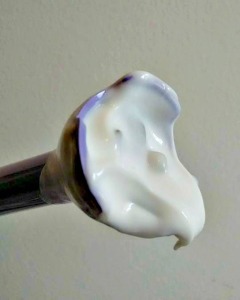
Researcher Observation: Despite the “fresh” aesthetic of the gel-creams, the sensory profile was surprisingly heavy. This is likely due to the Isohexadecane and Polysorbate 80 in the polymer blend, coupled with the lack of a balanced “Grease-Fall” (I utilized a single oil for these diagnostic tests).
Processing: The “Phase Inversion” Method
Unlike traditional O/W emulsions where the oil is added to water, I utilized a specific cold-process protocol for these batches:
- Phase B Dispersion: The Simulgel EG was added directly to the oil phase. Since the polymer is lipo-dispersible, this facilitates the swelling and “uncoiling” of the polymer chains once they contact water.
- Aqueous Introduction: Phase A (Water) was poured into Phase B.
- Homogenization: High-shear mixing (immersion mixer) was applied immediately to trigger the inversion and create a stable, glossy cream-gel.
Stress Testing: Electrolyte Sensitivity
Polymeric thickeners like Simulgel EG are notoriously sensitive to electrolytes (salts, proteins, acids). To quantify this, I introduced 1% Sodium Lactate to the 10% oil emulsion.
- Result: Immediate and total loss of viscosity. The polymer “lattice” collapsed, returning the emulsion to a liquid state.
- Formulation Solution: In my lab notes, I have recorded that to preserve viscosity in the presence of electrolytes, Simulgel EG must be paired with stabilizing gums (Xanthan or Guar).
Researcher Summary
Simulgel EG is an incredibly efficient tool for rapid, cold-process formulation, especially for batches involving heat-sensitive actives. However, it requires a strategic approach to lipids to avoid a “greasy” finish and a secondary rheology modifier (gums) if electrolytes like Sodium Lactate or Niacinamide are present in the formula.



 IT'S ALL IN MY HANDS
Nice post and nice waste 😀 .
About using gum if adding electrolytes, would adding it also reduce emulsifying power and then could seperate your cream potentially, Chiara?
LikeLike
It might affect emulsification if you add the gum in the entire amount of water before emulsification, that is why it would be better to separate the water in two: in one you let the gum hydrate, in the other you start the emulsification process, then combine. 🙂
LikeLike
Testing right now with Imwitor®375 (Glyceryl Citrate/Lactate/Linoleate/Oleate) and Simulgreen®18-2 (Hydroxystearyl Alcohol & Hydroxystearyl Glucoside)
Both work well with lower Oil phases.
Imwitor may be used cold or hot, but does not thiken.
LikeLike
Thanks Alexandra! I have Imwitor, will try it soon as well! 😉
LikeLike
Have you ever heard of Carbopol Ultrez 100?
LikeLike
Hi Daniela. Actually not. Is it something you have used?
LikeLike